Relying on the correct Waterproof IP Ratings (Estándar) prevents catastrophic equipment failure and skyrocketing warranty claims in harsh environments. Misjudging the exact threshold between IP55 rain resistance and IP69K high-pressure washdown defense leaves expensive internal components entirely exposed to moisture.
This analysis benchmarks IEC 60529 testing protocols against real-world industrial demands. SHIJIE evaluate precise hydrostatic pressure limits, submersion testing standards, and elastomer gasket material performance across EPDM and silicone to ensure your enclosures maintain absolute sealing integrity.
What is an IP Rating?
An IP rating is a standardized code defined by IEC 60529 that dictates how well an electrical enclosure blocks dust and liquids from damaging internal components.
Definition and Industry Standard
An IP (Ingress Protection) rating acts as a universal metric for hardware durability. It specifies exactly how much protection an electrical enclosure provides against solid foreign objects and liquid moisture.
The International Electrotechnical Commission created the IEC 60529 standard to eliminate vague marketing terms like “water-resistant.” This standardized code gives engineers and buyers hard data to guarantee safety and reliable functionality when deploying equipment across harsh industrial, marina, or outdoor environments.
Breakdown of the Two Digits
The rating format always begins with the letters “IP” followed by two specific numbers. If a manufacturer skips testing for a particular category, they replace that number with an “X” to indicate the untested status.
- First Digit (0 a 6): Measures protection against solid particles. This scale moves from blocking basic hazards like large tools or hands down to completely sealing out microscopic dust.
- Second Digit (0 a 9): Measures resistance to liquids. Testing evaluates performance against water intrusion, scaling from light vertical drips up to high-pressure sprays and complete underwater immersion.
First Digit: Solids & Dust Protection
The first digit of an IP rating defines an enclosure’s defense against solid objects. It scales from zero protection up to absolute dust-tight sealing for extreme environments.
Rating Scale from 0 a 6
The 0 a 6 scale measures exactly what size of solid object can breach an enclosure. Each number represents a tighter physical barrier against foreign solids.
- Levels 0 through 4: These lower tiers block distinct solid objects ranging from body parts like hands and fingers down to 1mm wires and small insects.
- Level 5: This tier offers strong dust protection that keeps equipment operational, even if minor amounts of dust enter the enclosure.
- Level 6: The highest rating provides complete dust-tight sealing. It blocks all microscopic particles from entering the device, even under intense vacuum conditions.
Testing Standards and Real-World Applications
Manufacturers test Level 6 devices using prolonged talcum powder exposure inside specialized vacuum chambers. This strict standard guarantees equipment survival in extreme environments like construction sites and deserts.
Facilities regularly choose IP5X ratings for indoor control rooms or moderately dusty manufacturing floors. In these spaces, minor airborne dust exists but won’t cause catastrophic system failure.
An ‘X’ in the first digit spot indicates the manufacturer did not test the device for solid object protection. They bypassed the dust chamber to focus entirely on liquid ingress testing.
Second Digit: Liquid & Water Protection
The second digit in an IP rating defines an enclosure’s liquid defense, scaling from zero protection to surviving high-pressure, high-temperature industrial washdowns.
Water Protection Levels 0 Through 9K
The liquid protection scale measures exact thresholds for moisture defense, divided into four primary performance tiers:
- Levels 0 a 4: Cover light moisture exposure, ranging from vertical condensation drips to multi-directional rain splashes.
- Levels 5 y 6: Handle low and high-pressure water jets, ensuring enclosures block forceful water streams from any direction.
- Levels 7 y 8: Define immersion limits by testing temporary submersions at 1 meter and continuous deep-water exposure based on manufacturer specifications.
- Level 9K: Sets the maximum standard, proving the enclosure withstands close-range, high-temperature, and high-pressure industrial washes.
Testing Principles and Application Guidelines
Laboratories test these ratings using fresh water. Devices require separate certifications to handle saltwater, oils, or industrial solvents.
You must also track how these ratings stack. Ratings stop accumulating after IPX6. An IPX7 submersion device might fail a water jet test. To prove resistance against both conditions, the manufacturer must list a dual rating like IPX5/IPX7.
Field application dictates the target rating. Everyday consumer electronics usually target IPX4 for rain resistance. Marine and heavy industrial tools demand IPX8 or IPX9K to survive harsh, high-moisture environments.
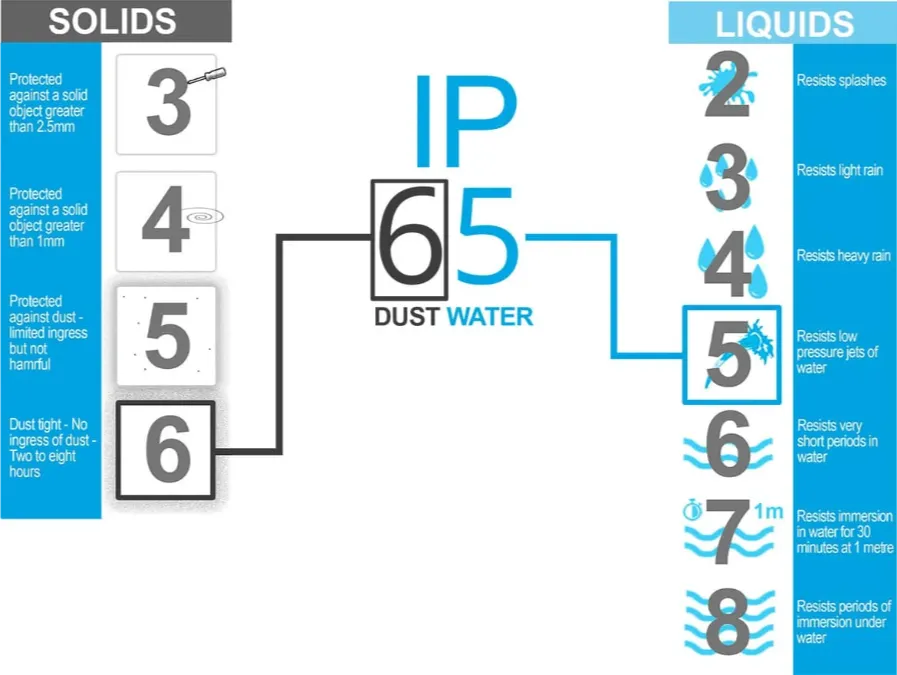
IP55 vs IP65 for Outdoor Use
IP65 completely blocks dust and withstands heavy rain, while IP55 allows minor dust ingress and suits only sheltered outdoor installations.
The comparison table below acts as a practical waterproof ratings chart for selecting the right enclosure performance outdoors.
| Feature | IP55 | IP65 |
|---|---|---|
| Dust Protection | Allows limited ingress | 100% dust-tight |
| Water Resistance | Low-pressure jets | Heavy rain and strong sprays |
| Outdoor Suitability | Sheltered areas only | Fully exposed environments |
Core Differences in Dust and Water Resistance
The primary distinction between IP55 and IP65 lies in their ability to handle fine particles and sustained moisture. IP65 completely blocks all dust particles from entering the enclosure. This absolute seal makes it mandatory for dusty industrial sites, construction zones, and agricultural facilities. IP55 allows limited dust entry, provided the ingress does not stop the equipment’s normal operation. This lower threshold works well for cleaner environments.
Both ratings easily withstand low-pressure water jets hitting the enclosure from any direction. But IP65 outperforms IP55 under environmental stress. IP65 handles higher-pressure sprays and heavy rain much better. If you leave an IP55 device in a severe rainstorm for prolonged periods, the seals will eventually fail and allow water to breach the system.
Ideal Outdoor Applications for Each Rating
Matching the right IP rating to your installation site prevents premature equipment failure. You should pick IP55 exclusively for sheltered outdoor areas. Great use cases include covered HVAC units, porch lighting, or equipment installed under deep eaves where wind-blown rain and dust remain minimal.
Select IP65 for fully exposed outdoor applications. You need this level of protection for:
- Security Cameras: Units mounted on open poles or exterior walls facing direct weather.
- Outdoor Lighting: Streetlights and floodlights exposed to heavy storms.
- Industrial Machinery: Equipment requiring frequent washdowns to maintain operational standards.
Evaluate your specific environmental risks before making a final purchasing decision. Keep in mind that neither IP55 nor IP65 supports underwater immersion. If your installation site carries a risk of flooding or requires temporary submersion, upgrade your hardware to an IP67 rating.
For a deeper comparison of protection levels, see our detailed guide on IP55 vs IP67 enclosures.
Common Waterproof Testing Procedures
Waterproof testing exposes enclosures to calibrated water volumes, pressures, and temperatures to verify sealing integrity across different IPX levels.
Dripping, Spraying, and Water Jet Tests
Laboratories simulate rain and direct water exposure to validate lower to mid-tier IP ratings. These tests confirm the enclosure handles surface-level moisture without allowing water to bypass the exterior seals.
- IPX1 and IPX2 (Dripping Water): Evaluates protection against falling droplets or condensation. Technicians tilt the unit up to 15 degrees to check for vulnerabilities at slight angles.
- IPX3 and IPX4 (Spraying and Splashing): Involves oscillating sprays or specialized nozzles. The process ensures no moisture penetrates the casing when water hits from various angles.
- IPX5 and IPX6 (Water Jets): Blasts units with low- and high-pressure water from specified nozzles. Testers maintain a distance of 3 meters and direct the spray for several minutes per side.
Submersion and Extreme Exposure Tests
High-level IP ratings require intense physical conditions to validate seals against hydrostatic pressure and extreme temperatures. These procedures test the limits of the gaskets and enclosure design.
- IPX7 (Temporary Immersion): Requires submerging the unit in water up to 1 meter deep for 30 minutes. This checks the structural integrity of the seals under static pressure.
- IPX8 (Continuous Immersion): Pushes enclosures beyond the 1-meter mark. Testing runs for longer durations based on specific manufacturer operating requirements.
- IPX9 (High-Temperature Jets): Exposes units to 80°C water jets at close range. This simulates heavy-duty industrial washdowns and harsh cleaning environments.
Material Impact on Sealing Performance
Material elasticity and hardness dictate seal survival under hydrostatic pressure. Choosing the exact elastomer prevents water ingress during strict IPX7 and IPX8 immersion tests.
Core Properties Driving Seal Reliability
Elasticity dictates how tightly a material compresses against mating surfaces. You need sufficient hardness to sustain that seal when pressure spikes. Low-pressure IPX7 applications rely on moderate hardness to keep water out. Moving to IP68 ratings demands materials built to handle water equivalents well beyond 14.2 psi.
Hydrostatic pressure forces seals to compress inward during IPX8 immersion tests. The material must fully recover its original shape immediately to prevent micro-gaps. The seal must also fight off environmental degradation from weathering, UV exposure, and extreme temperature shifts.
Common Elastomers for IP Ratings
Engineers rely on specific elastomers to match the exact environmental demands of the target IP rating.
- EPDM Rubber: Delivers massive resistance to UV and ozone. It fits IP66, IP67, and IP68 requirements for outdoor exposure perfectly.
- Nitrile Rubber (NBR): Provides aggressive resistance to oil and fuel. This makes it the standard for industrial machinery exposed to harsh contaminants.
- Silicone Rubber: Maintains physical flexibility across severe temperature ranges from -60°C to 200°C. Manufacturers use it to support continuous IP68 submersion protocols.
- Viton (FKM): Handles extreme high-pressure jets and aggressive chemicals. This compound meets the unforgiving requirements of IP69K standards.
Gasket Selection: EPDM vs Silicone
EPDM dominates outdoor IP65+ enclosures with superior water resistance. Silicone excels in extreme heat up to +250°C but risks swelling under prolonged water exposure without specialized modifications.
Key Material Properties
EPDM delivers strong water resistance with minimal swelling. Manufacturers rely on it to defend against continuous weathering, steam, and physical abrasion. It also resists acids and alkalis effectively, maintaining seal integrity in harsh chemical environments.
Silicone withstands extreme temperatures up to +250°C and recovers its shape quickly in dynamic seals. It easily handles oils and fire-resistant fluids. You must use modified formulations if the application involves prolonged water exposure, as standard silicone absorbs moisture and swells over time.
Application Selection Guidelines
Your operating environment dictates the right gasket material. Match the elastomer to your specific exposure risks to prevent premature seal failure.
- Outdoor Enclosures: Opt for EPDM in outdoor IP65+ enclosures where weather exposure, abrasion tolerance, and cost-effectiveness drive the design.
- High-Heat Electronics: Specify silicone for setups needing continuous flexibility, dynamic sealing, and dielectric insulation at elevated temperatures.
- Environmental Hazards: Assess specific site risks like acid rain or submersion. Standard silicone risks swelling and failure under these conditions compared to EPDM.
How SHIJIE Ensures Waterproof Integrity
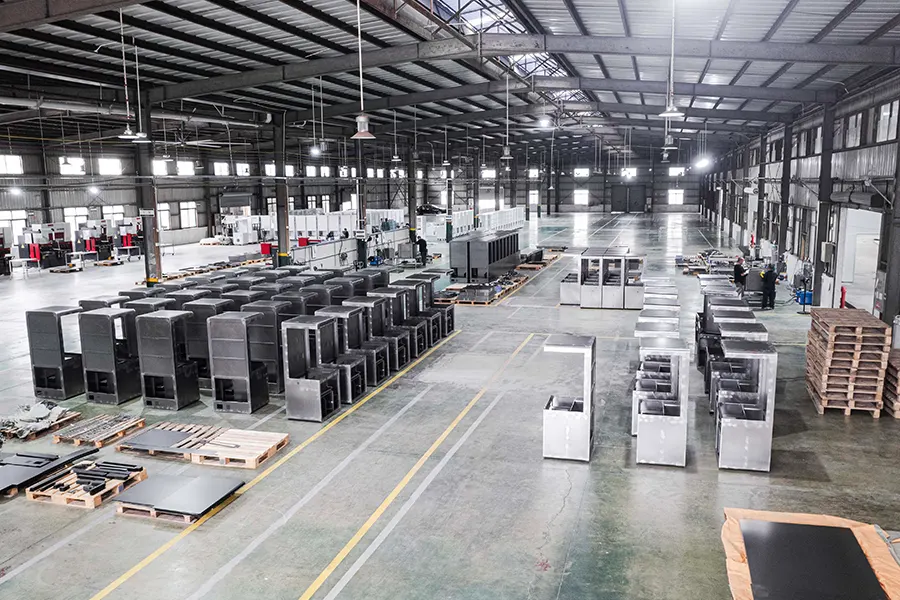
SHIJIE achieves IP65 waterproof integrity through ±0.01 mm precision laser cutting, seamless welding, and rigorous environmental testing to block dust and water ingress entirely.
Precision Manufacturing for Seamless Construction
Waterproof enclosures fail when structural gaps allow moisture to bypass the seals. We engineer out these vulnerabilities early by embedding exact waterproof specifications directly into the core design blueprints.
Our production floor executes these requirements through heavily controlled manufacturing steps:
- Blueprint integration: Engineers design blueprints with exact waterproof specifications to meet functional requirements.
- Laser precision: Laser cutting machinery achieves strict ±0.01 mm tolerances to minimize gaps during component fitment.
- Seamless assembly: Production teams weld and join parts directly to eliminate leak paths and build a durable shape.
Reliable Industrial Enclosures Built To Last
Rigorous Testing for IP65 Standards
Building a sealed structure is only the first phase. Validating its physical performance under environmental stress guarantees long-term field reliability. We run multi-stage inspections to confirm true IP65 compliance.
The quality control sequence targets specific failure points before any unit ships:
- Environmental simulation: Quality teams run IP protection tests simulating environmental exposure to verify IP55 and IP65 dust and water resistance.
- Tolerance verification: Full dimensional inspections confirm structural tolerances match the original drawings for tight, secure seals.
- Coating checks: Inspectors check surface coatings for uniform adhesion to prevent corrosion during heavy-duty outdoor use.
Discover more trusted partners in our curated list of top sheet metal enclosure manufacturers worldwide.
Frequently Asked Questions
What does IP67 waterproof mean?
IP67 is an Ingress Protection standard meaning a device is completely dust-tight (the ‘6’) and withstands temporary water immersion (the ‘7’). Devices rated IP67 survive submersion in up to 1 meter of fresh water for 30 minutes. Industrial manufacturers rely on this benchmark for outdoor enclosures, lighting, and rugged electronics.
Is IP65 or IP67 better for rain?
IP67 delivers superior protection for rain, especially in severe weather or flood-prone zones. Both ratings fully block dust. IP65 resists low-pressure water jets, handling standard rainfall perfectly well. IP67 survives complete temporary submersion, making it the strict requirement for heavy downpours or installations near active water features.
Can IP68 be submerged indefinitely?
No. An IP68 rating does not guarantee indefinite submersion. The ‘8’ signifies protection against continuous immersion beyond 1 meter, but manufacturers define the exact depth and time limits. A consumer device might survive 1.5 meters for 30 minutes, while industrial probes handle 300 meters. Real-world variables like hydrostatic pressure, aging seals, and saltwater corrosion will eventually breach any enclosure.
What is the difference between IP ratings and NEMA?
The global IP rating system tests exclusively for solid and liquid ingress. North American NEMA ratings evaluate a much wider set of environmental threats, including corrosion, ice formation, and explosive gases. NEMA standards usually meet or exceed their IP equivalents, but no exact one-to-one correlation exists because NEMA involves stricter, multi-variable testing.
How do testers evaluate IP ratings?
Certified labs evaluate IP ratings using the IEC 60529 standard. To test dust resistance, technicians place the enclosure in a vacuum chamber filled with agitated talcum powder and measure internal accumulation. For liquid tests, they blast the unit with pressurized nozzles, oscillating spray tubes, or submerge it in regulated water tanks to verify the seals hold against harmful ingress.
What is a good IP rating for outdoor use?
Ratings between IP44 and IP65 suit most standard outdoor applications. IP44 acts as the absolute baseline, blocking splashing rain from all directions. If your site involves heavy dust or pressure washing, step up to IP65 for dust-tight, jet-resistant sealing. Only specify higher ratings like IP67 or IP68 if the equipment risks complete water submersion.
Final Thoughts
Settling for an inadequate IP rating exposes your internal electrical components to catastrophic water and dust failure. While generic enclosures offer lower upfront costs, SHIJIE’s precision-engineered IP standards safeguard your infrastructure against harsh environmental degradation. Specifying the right gasket material and demanding verified testing protocols eliminates the heavy financial risks of premature field failures.
Stop guessing on your environmental protection limits and verify the hardware quality directly. We recommend starting with a sample order to test our seamless welding and ±0.01 mm precision tolerances firsthand. Contact our manufacturing team to discuss your specific OEM requirements and secure the exact IP rating your project demands.