Selecting the right enclosure rating for corrosive environments directly affects your maintenance costs, asset lifespan, and unplanned downtime. For B2B procurement teams evaluating Gabinetes NEMA 4X, understanding the gap between standard weatherproof ratings and verified corrosion resistance is the difference between a reliable installation and a recurring replacement cycle.
This guide benchmarks NEMA 4 and NEMA 12 against NEMA 4X performance criteria, evaluates ASTM B117 salt spray resistance, the 65 GPM high-pressure water jet standard, and material durability across stainless steel and non-metallic polymers. By the end, you will know exactly which specification fits your facility’s chemical, thermal, and moisture profile.
What Is NEMA 4X Rating?

NEMA 4X ratings define electrical enclosures that provide comprehensive protection against windblown dust, high-pressure water jets, and ice formation, while adding certified corrosion resistance for harsh industrial environments.
A NEMA 4X enclosure serves as a engineered defense system for electrical and electronic components. It keeps interior circuits dry and clean, blocking windblown dust, sujeira, chuva, granizo, and snow from breaching the seal. A Associação Nacional de Fabricantes Elétricos (NÃO HÁ) publishes the standard that governs these performance ratings for electrical enclosures.
To qualify for the 4X designation, enclosures must pass the same rigorous water ingress tests as standard NEMA 4, plus additional corrosion resistance evaluation:
- Water Flow Rate: Testers spray at least 65 GPM (gallons per minute) of water directly at the seams.
- Nozzle Size: A 1-inch nozzle directs the high-volume stream.
- Distance and Duration: The spray originates at least 10 feet away and continues for a minimum of 5 minutos.
- Ice Management: External ice formation must not damage the enclosure or compromise the physical seal.
- Resistência à corrosão: The enclosure must withstand prolonged exposure to salt spray, chemical agents, or other corrosive atmospheres without structural degradation.
O “X” suffix marks the dividing line between standard wet-weather protection and verified survival in aggressive atmospheres. Standard NEMA 4 enclosures block water and dust effectively, but they rely on painted or powder-coated carbon steel that will eventually rust when exposed to salt, acids, or industrial cleaning chemistry. NEMA 4X requires the use of inherently corrosion-resistant materials—such as 316 aço inoxidável, fiberglass-reinforced polyester, or UV-stabilized polymers—and passing specialized tests like ASTM B117 salt spray exposure for 200 para 600 horas.
An important distinction: NEMA 4X addresses environmental hazards and corrosion, not explosive atmospheres. If your facility handles flammable gases or combustible dusts, you need separate hazardous-location certifications (such as UL or ATEX Ex ratings) rather than a standard 4X enclosure.
NEMA 4X Protection Requirements and Testing
NEMA 4X enclosures combine dust-tight and watertight protection with verified corrosion resistance, designed for washdown, marinho, and chemical environments where standard painted steel fails.
Ingress and Environmental Barrier Protections
To achieve a NEMA 4X rating, an enclosure must maintain a continuous physical barrier against extreme airborne particulates and high-volume water exposure. The ingress protections include:
- Particulate Barrier: Completely dust-tight against windblown dust, falling dirt, fibras, and flying particles.
- Precipitation Shielding: Resists rain, granizo, neve, and splashing water from any direction.
- Hose-Down Resistance: The same 65 GPM test described above prevents water ingress during direct high-volume spray exposure.
- External Ice Management: Maintains structural integrity and seal protection when external ice forms on the enclosure surface.
Corrosion Resistance Testing and Certification
O “X” suffix represents verified corrosion resistance, marking the boundary where standard painted steel enclosures fail in hostile environments. True 4X designs protect every external component—including hinges, colchetes, and fasteners—against chemical and atmospheric degradation.
The qualification process typically involves the following test standards:
- ASTM B117 Salt Spray Test: Continuous exposure to a 5% sodium chloride mist for 200 para 600 horas, depending on the material and manufacturer specification. The enclosure is evaluated for surface degradation, bolhas, and structural integrity after exposure.
- Water Ingress Test: O 65 GPM hose-down test shared with NEMA 4, confirming that no water penetrates the gasket seals or cable entry points.
- UV Resistance (non-metallic enclosures): Polycarbonate and FRP enclosures intended for outdoor deployment are evaluated for UV degradation, color stability, and impact retention over time.
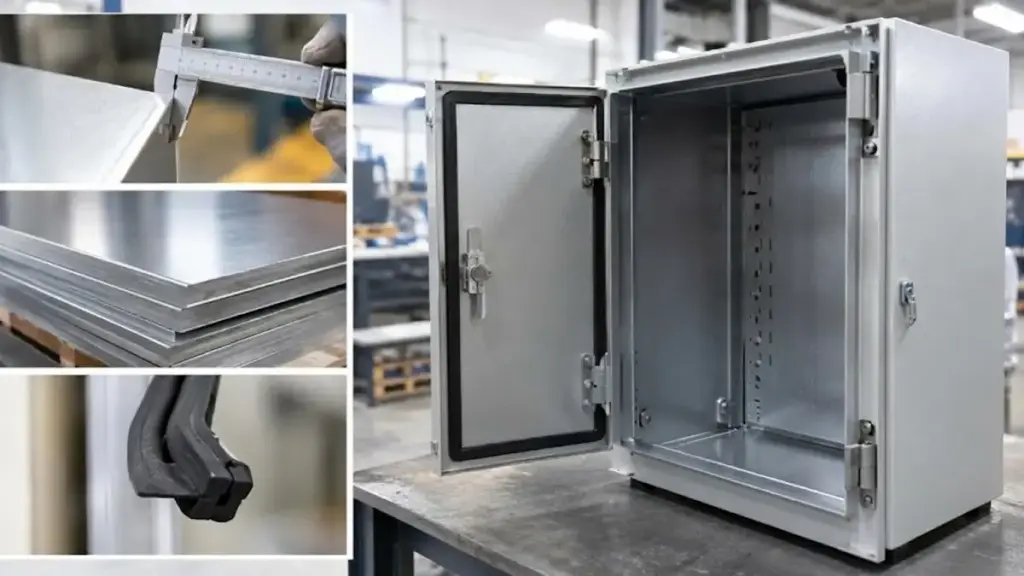
Manufacturers must also ensure that all accessory components—hinges, travas, fasteners, and gaskets—meet the same corrosion resistance standard as the enclosure body. A 316 stainless steel cabinet with carbon steel hinges, por exemplo, would not qualify as a true 4X solution because the hinges become the first point of failure.
For procurement teams, requesting test documentation is a standard part of the qualification process. Reputable manufacturers maintain traceable material certifications and can provide test reports upon request. This documentation becomes important during facility audits, insurance assessments, and compliance reviews.
NEMA 4X Enclosure Materials: Metallic vs. Non-Metallic Options

NEMA 4X performance relies on certified corrosion resistance. Selecting the correct metallic or non-metallic option directly protects your internal systems and lifecycle budget.
Metallic Options
- Tipo 316 Aço inoxidável: The preferred choice for coastal, offshore, and high-chloride chemical environments. Molybdenum content (2-3%) provides resistance to chloride pitting and crevice corrosion. Typical applications include marine platforms, chemical processing, and pharmaceutical washdown zones.
- Tipo 304 Aço inoxidável: Highly cleanable and mechanically strong, designed for food processing, beverage, and general sanitary washdown areas where chloride exposure is limited. Offers excellent formability for custom enclosure configurations.
- Aluminum with Protective Coatings: Lighter than steel, suitable for applications where weight matters. Requires high-performance anodized or powder-coated finishes to pass 4X corrosion tests.
Non-Metallic Options
- Fiberglass-Reinforced Polyester (FRP): Delivers excellent chemical resistance and electrical insulation while keeping the unit lightweight. FRP enclosures do not corrode, making them a practical choice for wastewater treatment plants and dosing skids where acids and alkalis are present.
- Engineered Polycarbonate: High impact resistance with built-in UV stability. Ideal for smaller junction boxes, outdoor telemetry enclosures, and applications where transparent covers simplify visual inspections without opening the cabinet.
Selection Factors Beyond Corrosion
Material choice should account for the full environmental profile, not just the primary corrosive agent:
- UV Exposure: Outdoor installations in high-sun regions benefit from polycarbonate or UV-stabilized FRP. Stainless steel performs well in all UV conditions.
- Temperature Extremes: Stainless steel handles wider temperature ranges than polymers. For high-heat environments (above 80°C continuous), metallic options are typically specified.
- Weight Constraints: Elevated installations or weight-sensitive mounting structures may require non-metallic alternatives, which can weigh 40-60% less than equivalent stainless steel units.
- Chemical Specificity: Different chemicals attack different materials. Hydrochloric acid, por exemplo, damages stainless steel but is well tolerated by FRP. Specify based on the actual chemical profile of your facility.
NEMA 4X Applications in Industrial Environments

NEMA 4X enclosures protect electrical components from high-pressure washdowns, spray de sal, e produtos químicos corrosivos, preventing premature asset failure in harsh industrial environments.
Key Deployment Sectors
- Food and Beverage Processing: Daily high-pressure caustic washdowns strip standard coatings. NEMA 4X stainless steel cabinets are typically specified for motor starters, PLCs, and junction boxes in these zones.
- Marine and Offshore: Constant salt spray and high-salinity air accelerate corrosion in standard metal housings. Deck-level and dock-side installations require tight environmental sealing paired with verified salt-spray resistance.
- Wastewater Treatment: Facilities manage aggressive gases like hydrogen sulfide and chlorine alongside direct chemical splashes. Both moisture ingress and chemical degradation must be resisted simultaneously.
- Chemical Processing: Enclosures near dosing skids, storage tanks, and mixing areas face periodic acid or alkali splashes. FRP and 316 stainless steel are the typical materials specified here.
- Agricultural Operations: Fertilizer storage, ammonia handling, and outdoor irrigation control systems expose enclosures to corrosive compounds and weather simultaneously.
Material-to-Environment Matching
The most common specification error is selecting a 4X enclosure based on the rating alone without matching the material to the specific chemical environment. A practical decision framework:
- General washdown, low chloride: 304 stainless steel typically provides adequate resistance at a lower cost than 316.
- Marine climate or chlorinated washdown: Upgrade to 316 aço inoxidável; its molybdenum content resists chloride-induced pitting.
- Acid or alkali exposure, non-conductive requirement: FRP or polycarbonate resists these agents without rusting or conducting electricity.
- Lifecycle cost: Painted carbon steel costs less upfront but requires repainting and early replacement. NEMA 4X materials eliminate these maintenance cycles, typically delivering lower total cost of ownership over a 10-15 year service window.
Comparing NEMA 4X vs. Other Enclosure Ratings
NEMA 4X matches NEMA 4 and IP66 in water ingress sealing but adds validated corrosion resistance, separating it from indoor-only ratings like NEMA 12.
NEMA 4X vs. NÃO HÁ 4 and NEMA 12
Designers frequently confuse NEMA 4 and NEMA 4X because they share identical dust-tight and water-spray testing parameters. Both require the enclosure to withstand the 65 GPM hose-down test. The defining difference lies entirely in corrosion protection: NEMA 4X requires materials or finishes that pass salt spray testing, while standard NEMA 4 enclosures use painted carbon steel that rusts when exposed to chemical washdowns or coastal salt air. For a detailed breakdown of these two ratings, see our NÃO HÁ 4 vs 4X comparison guide.
NÃO HÁ 12 serves a different purpose. It protects indoor equipment from circulating dust, fiapos, fibras, e gotejamento de líquidos não corrosivos. It offers no defense against outdoor weather, high-volume washdowns, or corrosive elements. If you spray a NEMA 12 enclosure with a washdown hose, water will bypass the seals and damage the internal electronics.
| Rating | Ambiente | Proteção da Água | Resistência à corrosão |
|---|---|---|---|
| NEMA 4X | Interior / Ar livre | Heavy washdown (65 GPM), chuva, neve | Sim (ASTM B117 salt spray) |
| NÃO HÁ 4 | Interior / Ar livre | Heavy washdown (65 GPM), chuva, neve | Não |
| NÃO HÁ 12 | Indoor Only | Light dripping and splashing only | Não |
| IP66 | Depends on material | High-pressure water jets | Não (ingress only) |
| IP67 | Depends on material | Temporary submersion (1eu, 30 min) | Não (ingress only) |
| IP69K | Depends on material | Close-range, high-temp, high-pressure washdown | Não (ingress only) |
NEMA 4X vs. IP66, IP67, and IP69K
The international IEC IP system and the North American NEMA system use different testing protocols, so they do not align perfectly. IP66 provides an equivalent level of ingress protection to NEMA 4X—certifying that the enclosure is dust-tight and defends against high-pressure water jets. No entanto, the IP testing sequence focuses strictly on water and solid ingress. It does not evaluate environmental factors such as corrosion resistance, outdoor UV degradation, or structural damage caused by external ice formation.
IP67 certifies temporary submersion (1 meter depth, 30 minutos), and IP69K certifies close-range, alta temperatura, ultra-high-pressure sanitization. Despite these advanced water ingress capabilities, neither IP67 nor IP69K guarantees long-term chemical or salt corrosion resistance on its own. Engineers must evaluate construction materials alongside the IP rating to ensure both water sealing and material survival.
How to Specify NEMA 4X Enclosures for Your Facility
For B2B procurement teams, selecting NEMA 4X enclosures involves more than confirming the rating label. A structured specification process reduces the risk of material-environment mismatch and costly field replacements:
- Etapa 1 — Environmental Assessment: Document the specific corrosive agents present (salt air, chlorine, hydrogen sulfide, caustic cleaners, acids), their concentration, exposure frequency, and ambient temperature range. Include both normal operations and washdown or maintenance cycles.
- Etapa 2 — Material Shortlist: Match the environmental profile to material properties. For mixed environments with both moisture and chemical exposure, request material data sheets from at least two qualified manufacturers.
- Etapa 3 — Certification Verification: Request ASTM B117 test reports and confirm that all components—hinges, fasteners, gaskets—share the same corrosion rating as the enclosure body.
- Etapa 4 — Sample Evaluation: For large deployments, request physical samples to inspect gasket quality, weld consistency, and finish before committing to volume orders.
- Etapa 5 — Lifecycle Cost Analysis: Compare total cost of ownership over a 10-15 year window, including replacement cycles, maintenance labor, and unplanned downtime—not just the unit purchase price.
Documentation matters as much as the physical product. When you receive enclosures, verify that each shipment includes material certificates (mill test reports for stainless steel, UL recognition cards where applicable), a copy of the ASTM B117 or equivalent test summary, and dimensional drawings matching your approved specification. These documents support facility audits, insurance compliance, and traceability requirements that many B2B buyers face from their own customers. A manufacturer that cannot provide this paperwork on request is a procurement risk—regardless of how competitive the unit price may appear.
Considerações Finais
Opting for standard painted steel may reduce upfront costs, but it exposes electrical systems to accelerated corrosion and unplanned field failure in harsh environments. Specifying NEMA 4X enclosures with the right material for your chemical and moisture profile protects equipment against washdowns, spray de sal, and extreme weather—while reducing long-term maintenance and replacement costs.
If you are evaluating NEMA 4X enclosures for an upcoming project, we recommend requesting material samples and test documentation to verify that the enclosure meets your facility’s specific corrosion profile. Our engineering team can help match specifications to your environmental requirements and provide competitive volume pricing.
Whether you need a small batch of custom junction boxes or a large deployment of control panel enclosures across multiple facilities, the right specification today prevents the most expensive problems tomorrow—field failures, unplanned downtime, and premature replacement cycles that far exceed the initial savings of an underspecified enclosure.
Perguntas frequentes
What does NEMA 4X mean?
NEMA 4X is a standard for electrical enclosures indicating protection against dust, chuva, gelo, and direct water sprays, combined with verified corrosion resistance. O “X” suffix signals that the enclosure can withstand aggressive chemical exposure, salt water, and frequent washdowns in harsh indoor or outdoor environments—conditions that would degrade standard NEMA 4 enclosures over time.
Is NEMA 4X waterproof?
NEMA 4X enclosures are watertight against rain, splashing, and heavy hose-directed water jets (65 GPM), but they are not designed for submersion. For applications involving temporary or prolonged underwater exposure, specify NEMA 6 or NEMA 6P enclosures instead.
What is the difference between NEMA 4 and NEMA 4X?
Both ratings provide identical protection against dust, chuva, gelo, and hose-directed water. The sole difference is that NEMA 4X requires verified corrosion resistance through material selection (aço inoxidável, FRP, polycarbonate), whereas NEMA 4 enclosures typically use painted or powder-coated carbon steel that rusts when exposed to salt, produtos químicos, or coastal atmospheres.
Where are NEMA 4X enclosures used?
NEMA 4X enclosures are deployed in environments where moisture and corrosive agents coexist: food and beverage processing lines with daily caustic washdowns, marine docks and offshore platforms with constant salt air, chemical processing plants with acid or alkali exposure, instalações de tratamento de águas residuais, and agricultural operations with corrosive fertilizers.
Is stainless steel required for NEMA 4X?
Não. NEMA 4X is a performance standard, not a material specification. While 304 e 316 stainless steel are common choices, manufacturers also use fiberglass-reinforced polyester (FRP) for chemical resistance, polycarbonate for impact resistance and UV stability, and coated aluminum for weight-sensitive applications. Standard painted carbon steel is the common material that generally fails to meet 4X requirements.