The wrong NEMA cabinet rating during hardware sourcing can increase the risk of premature component failure, unplanned maintenance, and costly field downtime. An enclosure with insufficient environmental protection can leave sensitive electronics exposed to dust, umidità, o condizioni corrosive, increasing maintenance requirements and the risk of equipment failure.
This guide compares common NEMA enclosure types based on their environmental protection, typical applications, material considerations, and cost factors. The goal is to help engineers choose an enclosure suited to the installation environment.
What Are NEMA Cabinet Ratings and Why They Matter

NEMA ratings describe the environmental protection provided by electrical enclosures, helping engineers select cabinets that are suitable for specific operating conditions.
Understanding NEMA Design Standards and Enclosure Classifications
ANSI/NEMA 250 establishes requirements for electrical enclosures used in specified indoor, all'aperto, e luoghi pericolosi. The standard classifies enclosures according to the environmental conditions they are designed to withstand, including dirt, acqua, polvere portata dal vento, corrosione, and other hazards.
For industrial cabinet installations, the selected NEMA Type dictates exactly where a cabinet can operate safely. The core Tipi di custodie NEMA divide into distinct indoor and weatherproof outdoor categories:
- Tipo 1: General-purpose indoor cabinets protecting against accidental contact and falling dirt, with no water protection.
- Tipo 12: Dust-tight and drip-tight indoor enclosures designed to exclude circulating dust, lanugine, fibre, e gocciolamento di liquidi non corrosivi come oli o liquidi refrigeranti.
- Tipo 3R: Weatherproof outdoor enclosures that shed rain, nevischio, e neve, but do not provide tight windblown dust seals.
- Type 4X: Watertight and dust-tight enclosures designed for environments where corrosion resistance is also required, such as coastal, chemical-processing, and washdown applications. Stainless steel and other corrosion-resistant materials are commonly used.
Beyond basic protection from dust and water, NON C'È 250 also covers specialized enclosure types for hazardous locations. Tipo 7 enclosures are intended for certain Class I, Divisione 1 luoghi pericolosi, while Type 9 addresses specific combustible-dust environments. Other NEMA types address conditions such as outdoor icing, corrosione, and water exposure.
How Proper Enclosure Selection Prevents Failures and Ensures Compliance
Selecting the wrong cabinet rating poses severe compliance and safety risks. Facility engineers must select and install enclosures in accordance with the applicable NEC requirements and the enclosure manufacturer’s instructions. Using an enclosure that does not provide adequate environmental protection can increase the risk of equipment damage, electrical hazards, and costly downtime.
Moisture, polvere, and other contaminants can contribute to failures in PLCs, variable frequency drives, contactors, and other electrical components. A properly sealed enclosure keeps these contaminants out of critical control circuitry, maintaining continuous production and slashing maintenance overhead.
Optimizing hardware service life requires matching specific local hazards to the correct enclosure. A factory floor with oil mist demands a Type 12 cabinet, while a marine pump station requires a Type 4X stainless steel unit. Matching the enclosure to the actual site conditions helps protect the equipment and reduce premature replacement or maintenance.
Common NEMA Cabinet Rating Types and Their Uses
NEMA cabinet ratings help match electrical enclosures to specific environmental conditions. Choosing an appropriate Type can protect internal equipment and reduce the risk of contamination-related damage and unplanned downtime.
| NESSUN tipo | Common IEC IP Protection Reference | Primary Environment | Indicative Price Range |
|---|---|---|---|
| Tipo 1 | IP10–IP20 | Clean, dry indoor utility rooms | $50 – $200 |
| Tipo 3R | IP14–IP24 | Outdoor power distribution, rain/snow protection | $150 – $400 |
| Tipo 4 | IP55–IP66 | Washdown bays, heavy outdoor dust/rain | $300 – $800 |
| Type 4X | IP66 | Chemical processing, marino, sanitary washdown | $600 – $1,850 |
| Tipo 12 / 12K | IP52–IP54 | Factory floors, circulating dust, light drips | $200 – $600 |
NEMA Type and IEC IP classifications are not directly interchangeable. The IP references shown here are general cross-reference values and should not be treated as certification equivalents.
Environmental Protection and Application Profiles of NEMA Ratings
Enclosure selection is best based on the environmental conditions at the installation site. Matching the cabinet design to those conditions helps reduce contamination-related failures and unnecessary maintenance.
For indoor environments where atmospheric conditions remain controlled, specs focus on dust and light liquid protection:
- NESSUN tipo 1: Protects personnel from live parts and keeps out falling dirt. Ideal for clean, dry electrical rooms.
- NESSUN tipo 2: Adds drip-shields to handle condensation and overhead pipe leaks.
- NEMA Type 12/12K: Indoor enclosures designed to protect against falling dirt, circulating dust, lanugine, fibre, and dripping or light-splashing liquids. Tipo 12 is constructed without knockouts, while Type 12K allows knockouts for conduit entry.
- NESSUN tipo 13: Provides additional protection against the spraying, splashing, and seepage of oil and non-corrosive coolants, making it suitable for many machining and industrial environments.
Outdoor installations and areas with heavy water exposure generally require stronger sealing and weather protection, which is also a key consideration when selecting armadi elettrici esterni su misura.
- NEMA tipo 3R: The default outdoor distribution rating. It sheds rain, nevischio, e neve, resisting external ice damage, though it lacks tight dust seals.
- NEMA Type 4/4X: Watertight and dust-tight. Tipo 4 resists heavy hose-directed washdowns. Type 4X integrates 304/316 stainless steel or fiberglass to combat corrosive chemical vapors and saltwater.
- NEMA Type 6/6P: These Types are intended for applications involving water exposure and immersion. Tipo 6 covers occasional temporary submersion at a limited depth, while Type 6P covers prolonged submersion at a limited depth and adds corrosion protection.
Material selection can have a significant impact on enclosure cost. Carbon steel is often used for cost-sensitive indoor applications, while stainless steel and other corrosion-resistant materials are more common where washdown or corrosive conditions require additional protection. Final pricing also depends on enclosure size, sheet thickness, hardware, sealing, accessories, and order volume.
Industrial Selection Matrix and NEMA-to-IP Reference
Enclosure selection should start with the actual conditions at the installation site and the hazards the cabinet is expected to withstand. Facility criteria usually mandate specific types based on process severity:
- Chemical Sanitation & Food Processing: NEMA Type 4X is commonly considered where frequent washdown and corrosion exposure require both water protection and additional corrosion resistance.
- Municipal Wastewater: NEMA Type 4X may be appropriate for above-grade equipment exposed to corrosive conditions and washdown, while Type 6P may be considered where prolonged temporary submersion is a foreseeable risk. The final selection should follow the actual site conditions and applicable requirements.
- Utility Distribution: Use NEMA Type 3R to secure outdoor power lines and transformers against weather without inflating equipment costs.
When managing global supply chains, engineers often translate North American NEMA ratings into international Ingress Protection (IP) codes under IEC 60529. NEMA ratings include physical performance testing that IP codes ignore, making conversion a one-way path. NEMA Type 4X provides a level of protection that corresponds to key IP66 ingress requirements, while also addressing corrosion resistance. An IP66 enclosure, Tuttavia, does not automatically qualify as NEMA 4X because IP testing does not cover all of the additional environmental requirements included in NEMA Type ratings.
A practical way to select the enclosure is to work through the following steps:
- Fare un passo 1: Determine if the installation area is classified as hazardous. If the area is classified as hazardous, determine the applicable enclosure Type from the site’s Class, Divisione, Group, or Zone classification and the relevant NEC requirements.
- Fare un passo 2: Evaluate location. Clean indoor areas run reliably with cost-effective Type 1 or Type 12 recinzioni.
- Fare un passo 3: Audit outdoor and wet areas for corrosion risks. Upgrade from standard Type 4 to Type 4X if salt fog, acids, or harsh cleaning agents are present.
Custom NEMA Enclosures for Different Industrial Applications
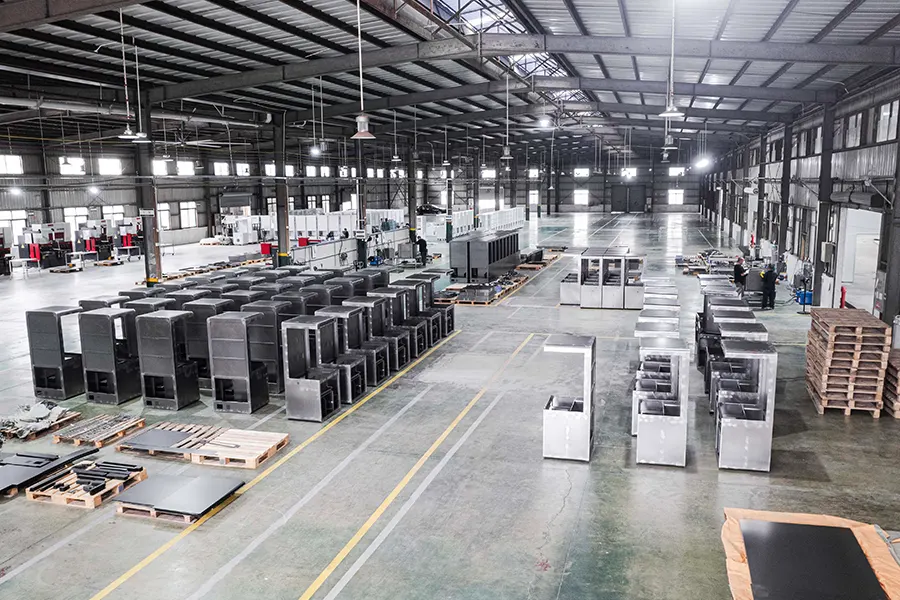
For projects with specific dimensions, mounting layouts, requisiti materiali, or environmental conditions, a standard enclosure may not provide the right fit. SHIJIE focuses on custom sheet metal enclosures for equipment manufacturers, integratori di sistema, and project-based applications. Its manufacturing capabilities cover laser cutting, stampaggio, flessione, saldatura, e trattamento superficiale, with options including acciaio al carbonio, acciaio inossidabile, E alluminio. The company also supports drawing- and sample-based customization, allowing customers to validate designs before moving into volume production. Applications include electrical cabinets, energy storage enclosures, vending machine housings, armadietti intelligenti, and other equipment housings. With large-scale production capacity and flexible manufacturing, SHIJIE can support both customized prototypes and larger production orders while adapting enclosure dimensions, openings, finishes, internal layouts, and other project-specific requirements.
Involucri elettrici personalizzati costruiti per durare
Comparing NEMA Cabinet Ratings to IP Protection Levels
NEMA Type ratings cover more than dust and water ingress. Depending on the Type, they can also address conditions such as corrosion, icing, olio, and coolants. IP codes focus primarily on protection against solids and water, so the two systems should not be treated as interchangeable.
Environmental scope differences between NEMA and IP standards
NON C'È 250 and IEC 60529 do not test enclosures against exactly the same environmental conditions. CEI 60529 IP codes focus strictly on ingress protection against solid foreign objects and water. They ignore how a cabinet survives long-term exposure to aggressive chemicals, tempo all'aperto, or industrial fluids.
NON C'È 250 specifies structural integrity and tests for hazards that IP codes exclude. This environmental scope includes:
- Resistenza alla corrosione: NEMA types like 4X require specific materials, such as 304 O 316 acciaio inossidabile, to withstand salt spray and chemical washdowns.
- Ice and low-temperature durability: Outdoor NEMA ratings ensure ice formation does not damage the cabinet or lock up external operating handles.
- Oil and coolant resistance: Ratings like NEMA 12 E 13 ensure gaskets withstand degraded industrial oils and cutting fluids.
This is why NEMA-to-IP comparisons should be treated as one-way references rather than direct equivalents. An enclosure meeting a NEMA Type may also satisfy certain IP ingress requirements, but an IP rating alone does not demonstrate compliance with the additional conditions covered by the corresponding NEMA Type.
Mapping NEMA types to IP codes for practical cabinet engineering
Engineers designing systems for global markets must map North American NEMA designations to international IP codes. For indoor applications, you can align dry-location cabinets by converting NEMA 1 to IP20. If the factory floor contains circulating particulates and oil mist, specify NEMA 12, which aligns with IP54 protection levels.
Outdoor installations demand stricter environmental limits. Map baseline NEMA 3R rainproof cabinets to IP24. When the installation faces heavy rain, acqua diretta tramite manichetta, or corrosive coastal conditions, NEMA Type 4X may be appropriate. NEMA 4X covers ingress conditions comparable to IP66 while also addressing corrosion resistance that is outside the scope of the IP system.
We map common baseline equivalents below:
- Indoor General Purpose: NON C'È 1 maps to IP20 (protects against contact, no water protection).
- Industriale per interni: NON C'È 12 maps to IP54 (protects against dust settling and light oil dripping).
- Outdoor Baseline: NEMA 3R maps to IP24 (protects against rain and sleet).
- Outdoor Washdown/Corrosive: NEMA 4X maps to IP66 (protects against powerful water jets and incorporates corrosion-resistant metals).
Do not make the mistake of reverse substitution. Before you replace a NEMA cabinet with an IP-rated alternative, verify the manufacturer’s certified test data. The alternative must have verified documentation proving it can handle the specific chemical, ghiaccio, and corrosion hazards of the environment.
Factors to Consider When Selecting NEMA Cabinet Ratings

Selecting the correct NEMA rating requires aligning site-specific environmental hazards with mechanical, regulatory, and lifecycle cost realities to protect vital electrical infrastructure.
Environmental and Atmospheric Site Conditions
The installation environment should be the starting point for enclosure selection. Ignoring dust, acqua, prodotti chimici, or temperature conditions can increase the risk of equipment damage and unexpected maintenance.
- Water exposure severity: Engineers map water hazards to specific ratings, selecting Type 2 O 12 for light drips, Type 3R for rain, Tipo 4 for high-pressure washdowns, and Type 6P for prolonged submersion.
- Particulate and dust concentration: Windblown dust, lanugine, and conductive particulates require tightly sealed Type 12 or Type 4 recinzioni, whereas clean indoor spaces can safely use Type 1.
- Corrosive environments and chemicals: Installazioni costiere, chemical plants, and food processing facilities with caustic washdowns require Type 4X ratings built from stainless steel or non-metallic materials.
- Temperature variations and ice accumulation: In freezing outdoor environments, consider enclosure Types that address external ice formation and the required operation of external mechanisms, such as Type 3S where applicable. Condensation inside the enclosure should be addressed separately through enclosure design and environmental control.
Mechanical, Regulatory, and Economic Requirements
Beyond weather, physical installation limits, local building codes, and initial capital expenditure budgets shape the final cabinet selection.
- Hazardous area classifications: Hazardous locations require a separate assessment based on the type of hazard and the applicable Class, Divisione, Group, or Zone classification. NEMA Types 7, 8, 9, E 10 apply to specific hazardous-location conditions rather than serving as a single general-purpose rating.
- Material performance and mechanical loads: Vibration, physical impact risk, and weight limits guide the choice between painted carbon steel, fiberglass, alluminio, O 316 acciaio inossidabile.
- Regulatory standards and local codes: Compliance with ANSI/NEMA 250 and national electrical codes sets the safety baseline for installation approval.
- Cost and long-term lifecycle value: While high-tier enclosures require higher initial spending, they lower lifetime maintenance, minimize downtime, and accommodate future system expansions.
Custom NEMA Cabinets and Enclosure Manufacturing Options

Matching enclosure materials and accessories to specific NEMA ingress criteria ensures long-term field reliability without costly over-engineering.
Material and Construction Standards for NEMA Compliance
Meeting NEMA enclosure standards requires selecting the right base metal and sealing method for your specific environment.
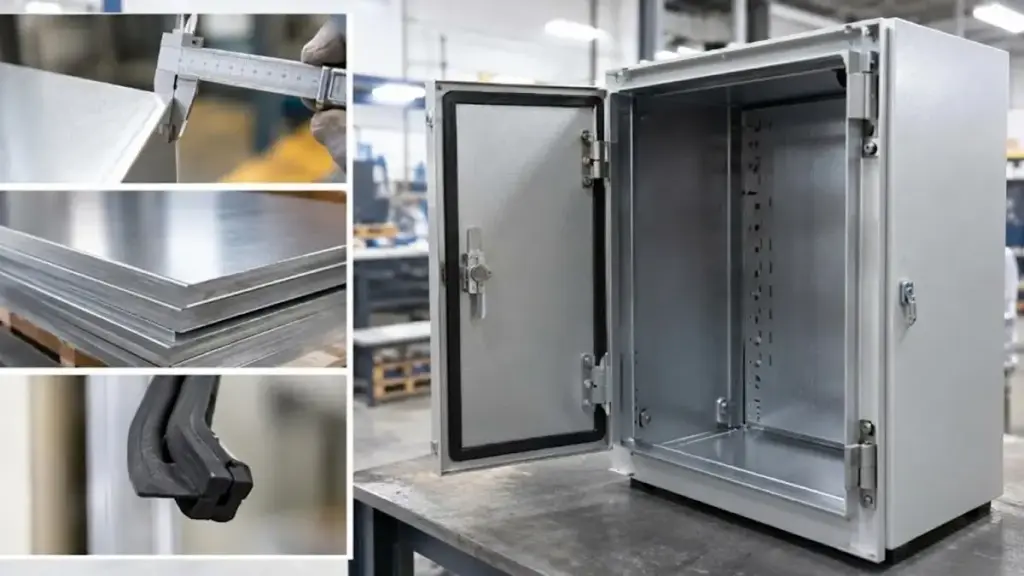
- Acciaio al carbonio: Powder-coated carbon steel is a common cost-effective option for many indoor and some outdoor enclosure applications, depending on the required NEMA Type and corrosion exposure.
- Acciaio inossidabile (304 O 316): Stainless steel is commonly selected for applications where higher corrosion resistance is needed, including many NEMA 4X and 6P applications. The appropriate grade depends on the site’s chemical, salt, and washdown exposure.
- Aluminum Alloys: These alloys deliver lightweight strength and natural corrosion defense, especially when treated with chemical conversion coatings.
- Continuous Gaskets: Polyurethane, silicone, and other suitable gasket materials can help maintain the environmental seal required for NEMA 4, 4X, E 12 applications when properly designed and tested.
- Welded Seams: Welded seams can reduce potential leak paths, but the complete enclosure design—including seams, guarnizioni, porte, hardware, openings, and cable entries—must be properly engineered and tested to achieve the target NEMA Type.
Integration of Thermal Management and Application Accessories
Customizing a cabinet involves integrating climate controls and mounting hardware while maintaining seal integrity.
- Active Cooling: Fans, scambiatori di calore, and air conditioners should be selected and installed so they do not compromise the enclosure’s intended NEMA Type. See our guide to sistemi di raffreddamento degli armadi elettrici for more information on thermal management options. Rated accessories and proper sealing around openings are important for maintaining environmental protection.
- Solar Shields: Secondary solar shields and double-wall designs minimize heat load in outdoor telecom installations.
- Interior Accessories: Swing-out panels, adjustable rack rails, and custom subpanels maximize component density inside the cabinet.
- Drainage Design: Drip shields and properly designed drainage features can help manage water while preserving the enclosure’s intended environmental protection. Their placement and construction should follow the applicable NEMA requirements.
- Third-Party Certification: Third-party testing or certification can provide documented evidence that an enclosure meets the claimed environmental rating. Depending on the market, this may include UL evaluation or other recognized certification programs.
Domande frequenti
What are the different NEMA cabinet ratings?
NEMA cabinet ratings describe the level of environmental protection an electrical enclosure is designed to provide. The specific Type determines the conditions the enclosure can handle. Per esempio, Tipo 1 is intended for general indoor use, Type 3R provides protection against rain, nevischio, e neve, and Types 4 and 4X are designed for dust-tight and watertight applications. Type 4X also adds corrosion resistance, making it suitable for environments such as coastal areas, chemical processing facilities, and washdown locations. Other Types, compreso 7 E 9, apply to specific hazardous-location conditions.
How do I choose a NEMA enclosure rating?
Start with the installation environment. Determine whether the enclosure will be installed indoors or outdoors and identify the main hazards, such as dust, piovere, washdown water, olio, prodotti chimici, corrosione, or temporary immersion. If the location is classified as hazardous, the applicable Class, Divisione, Group, or Zone requirements must also be considered. Choose the NEMA Type that covers the actual conditions at the site without adding protection that is not needed.
What is the difference between NEMA and IP ratings?
NEMA and IP ratings use different testing criteria and should not be treated as interchangeable. CEI 60529 IP codes focus mainly on protection against solid particles and water ingress, while NEMA enclosure Types can also address conditions such as corrosion, icing, olio, coolants, and certain hazardous-location requirements. A NEMA-rated enclosure may satisfy the ingress protection associated with a particular IP code, but an IP rating by itself does not demonstrate compliance with the corresponding NEMA Type.
Which NEMA rating is best for outdoor cabinets?
There is no single NEMA rating that is best for every outdoor installation. Type 3R is commonly used for general outdoor applications where protection from rain, nevischio, nevicare, and external ice is needed. Tipo 4 provides tighter protection against dust and water, including hose-directed water. Where corrosion from salt, prodotti chimici, or harsh washdown conditions is a concern, Type 4X is generally more appropriate.
Are NEMA ratings required for electrical cabinets?
The required enclosure protection depends on the installation conditions and the applicable electrical codes and standards. In U.S. installations, NEC requirements determine the level of environmental protection needed for electrical equipment, while NEMA Types are commonly used to specify and demonstrate the enclosure’s intended environmental performance. An IP rating should not be treated as a direct substitute for a NEMA enclosure Type where the applicable requirements call for a NEMA Type rating.
Can manufacturers customize NEMA cabinets?
Manufacturers can customize enclosure dimensions, materiali, cable cutouts, mounting layouts, porte, hardware, and thermal-management features for specific equipment and installation requirements. Tuttavia, modifications can affect the enclosure’s environmental performance. For projects that require a specific NEMA Type, the finished design should be properly engineered, tested, or certified as required to confirm that the target rating is maintained.
Considerazioni finali
Generic or unrated enclosures may have a lower initial cost, but they may not provide the environmental protection required for the installation. Choosing an enclosure with a verified and appropriate NEMA Type can reduce the risk of equipment damage, problemi di manutenzione, and compliance problems. A significant environmental ingress event can damage sensitive components, interrupt operations, and increase repair and replacement costs. Investing in the correct enclosure rating up front protects both your sensitive internal electronics and your company’s operational reputation.
Before placing a production order, review the enclosure drawings, material specifications, gasket design, hardware, and required NEMA Type documentation. For custom projects, sample approval or prototype inspection can also help confirm fit and build quality before volume production. Contact our engineering team today to discuss your specific OEM specifications, custom dimensions, and thermal management requirements.